Tuesday, April 13, 2010

A Little Different

Apologies; I have been remiss in my duties as a virtual host in that I have failed to offer you the grand tour of these new Northwestern surroundings. To address this egregious wrong, I invite you now to explore the strange familiarity of the Northwest.


I woke up this morning to an almost-familiar Hoot! Hoot! But the sound that would have been a train whistle in my Midwestern hometown was here the bleat of an ocean-going ship. Overseas, you expect things to be stunningly different: fern-trees and kiwi-birds, Greek-alphabet shop signs and Cyrillic train schedules. On this distant shore of our own country, things are not always as familiar as it seems like they should be.


A slug of unusual size

Take slugs. Instead of manageable brown ones inhabiting the cornstalks of my youth, those here grow into juicy six-inch cigars. Also, the chickadees are too small, the gulls are too big, the jays have shaved their crests, and the ducks sport mohawks. Bald eagles soar over the local Wal-Mart, whose front doors boast a first-rate view of a mountainous horizon. Rhododendron-like plants grow as skinny trees called madronas whose bark peels off in satisfying flakes. In backyards, ragged stands of cedars stretch to the clouds like gangly arbor vitae on prescription-strength Miracle-Gro. (Even these are juniors compared to the "grandfather trees" of the deep backcountry.) Below the trees, moss invades yards more militantly than dandelions. Green-rimmed waterways zigzag in every direction so that the air smells of salt and tidal mudflats instead of the algae and marshland of the Ten Thousand Lakes.


Treetops

The horizon, at least, bears no Midwestern tinge. Olympic National Park, whose crags peek over the western horizon, contains no rolling hills (and very few roads), report exhausted but glowing hikers. The Cascades stretch like a ragged wall across the landscape in the east, separating the temperate rainforests of Puget Sound from the high desert of Yakima and Spokane. But, on a clear day, even these great peaks look only as tall as rough cement compared to the Mountain. When it shows itself, Rainier appears an order of magnitude more massive than everything surrounding, as if someone had erected a giant magnifying glass on the far side of Tacoma. Strange, though, how such a bulk can camouflage itself so easily: its patchy snow blends with the wispy clouds to hide the mountain as you gaze into the distance, until something clicks in your brain and your eyes suddenly register the presence of something vast.


Rainier

According to Timothy Eagan's The Good Rain, Seattle gets less precipitation than New York, Boston, Washington, Philadelphia, and Miami (p. 49)—it just rains more often, as mists and light sprinkles. Thunderstorms are rare. A dark horizon doesn't always indicate a menacing front. There are all-day rains, but more often, it sprinkles off and on for several days, and it's hard to predict which will happen when. But even on these overcast days, when haze obscures the mountains, the sky puts on a quiet show. The clouds are infinitely creative performing artists. Of the many kinds of clouds Waukesha sees in a month, all of them at once might gather over the Northwest, each at its own altitude, each in its own costume, as if waiting in the wings for its cue to storm into Milwaukee or pour into New York.


Mist on Duckabush River

Some things remain familiar. As an indoctrinated practitioner of Minnesota Nice, I appreciate the series of commercials that heroize such Northwest characters as the guy who lets everyone else go first at a four-way stop (to the confusion and delay of all, including a bystanding jogger, in the ad). Kudos also go to the socks-and-sandals guy, the guy who camps under a tarp ("You bring your own blue skies"), and the Walla Walla wine wine woman woman. The sponsoring company claims that they are "A lot like you—a little different."


To this wandering Midwesterner, the Northwest is indeed a little different. And the little differences make all the difference in the world.

Saturday, April 10, 2010

Saturday, February 20, 2010

Trail Party

This week I discovered the Washington Trails Association (WTA). WTA organizes groups of volunteers to maintain existing trails and build new trails on public lands throughout the state. Today we worked on Taylor Mountain in the Issaquah Alps, a line of foothills that point from Seattle's Eastside into the Cascades. Most of the land on Taylor Mountain is owned by the county and is designated as a place for "passive recreation," including mountain biking, horseback riding, and, of course, hiking.

Playing in the dirt

WTA is helping to expand the trail system here. This means that WTA volunteers get to play in the mud, haul rocks around, take out aggressions on bystanding vegetation, laugh a bunch, and generally have a great time in the great outdoors. We gather at the trailhead at 8:30 (after driving for an hour toward a Mt. Rainier whose snows are tinged pink by the dawn) and work, more or less, until 2:30. A bucket of candy is passed around at 10:30, picnic lunch at noon, and breathers as often as you wish. Hard hats are in fashion (and if you join five work parties, you get a personalized one of your very own as a self-serving thank-you gift). The WTA supplies the tools—shovels, grub hoes, rakes, loppers, buckets—and once the crew leader outlines the plan, we get to work cutting brush, moving dirt, uprooting shrubs, redistributing rocks, and digging ditches. Turns out there's a lot more to building a durable, water-resistant trail than trimming a path through the underbrush.

At the end of the work day, we gather in the parking area, muddy and spent but in the high spirits of those who have completed a physically demanding but deeply satisfying task. Someone produces a Coleman cooler of steaming-hot washcloths for our hands and faces, and someone else pours plastic cups of hot apple cider to go with a bin of chocolate chip cookies. On these sunny springtime days, we stand around chatting for as long as possible before returning to the real world and its rush-hour traffic.

"Boot-sucking mud-holes"

I've joined two work parties so far. On Tuesday, we began with an abandoned road whose gravel surface had turned into a mud-clogged drainage ditch. (The WTA website uses the term "boot-sucking mud-holes" to describe trails like this one in their pre–work-party state.) By afternoon, we had prodded it into a somewhat wider dirt path edged with the suggestion of a rocky gutter.

The ten-person crew consisted almost entirely of retired men. Flannel and suspenders were conspicuous. One WTA veteran, a small man with a round, grinning, boyish face, had just turned 80 and worked just as hard as I did on the trail. Most of the crew had gotten to know each other through years of trail work and entertained me by trading wisecracks and wordplays and ridiculous stories (including something about "old-growth salmonberries").

The forest transformed

Today (Friday) I returned to the same stretch of trail. Trail crews had been out during the two intervening days, and it was amazing to see the trail's transformation. Where there had been a sketched-out gutter and a rough path, now there existed a well-formed and rockless canal next to a cobbled road. The walkway had been lined with watermelon-sized rocks and filled with fist-sized rocks to give it the appearance of a quaint country lane. A future crew would smooth a bed of sandy soil on top of the rocks to create an even, solid surface that drains instead of turning to mud. The trick is to remove any organic matter, which absorbs water, decays, and turns to muck. This painstakingly built but hidden structure underlies all trails where there is risk that water might seep into the trailbed.

Through the woods

Our job today was to create a gentle switchback from the cobbles through the forest to another trail section downhill. We ploughed through salmonberry bushes and blackberry tendrils, raked away many inches of leaf litter, pried large rocks out of the underlying soil, hacked at inconvenient roots, and moved a lot of dirt. My task was to shovel dirt that others had loosened into a satisfyingly large mound.

This time the women outnumbered the men on the 16-person crew. One sported French-tipped nails, another wore a fashionable hat when her head wasn't covered by her green plastic helmet. Another proudly displayed curly white hair and looks like she could have retired years ago but still kept busy as a physical therapist and avid hiker.

I'll ache tomorrow, but now I feel great.

Sunday, February 14, 2010

Browsing the Classifieds

Courtesy of the Kitsap Sun:
classified
Classified ad:
"Wanted: 1 pair
breeding Lovebirds"

Saturday, February 13, 2010

Winter Found

I found my winter: it's in Canada.

They commandeered our ice and snow to use in the 2010 Winter Olympic Games Opening Ceremonies. As a native of the Upper Midwest and a stalwart fan of cold seasons, the icy theme of this year's Games felt homey: bright white stars in a long, cold night; sparkling snow flurries; and, of course, the flaming ice crystal that is the cauldron of the Olympic Flame.

Other aspects more closely reflected my newest adoptive home. Vancouver is only about three and a half hours from Port Orchard (two and a half from Seattle). What we call the "Northwest" is only a thin border away from southwest Canada. We share a time zone and weather patterns. (It rained all day, here and there.) We both enjoy giant trees, Indian motifs, a mountainous horizon; we have in common an awe of orcas and a fondness for salmon. (Port Orchard even has its very own totem pole, on the waterfront next to the public library. And on every Puget Sound ferryboat are posters explaining how closely boaters are allowed to approach the orcas.)

And yet that thin border has some effect. I wanted to apply for Canadian citizenship by the time the poet described his homeland as the place whose people are renowned for their pleases and thank yous.

But before the echoes of the poet's words settled, NBC cut to a commercial for Marriage Ref—Welcome back to the U.S., where we enjoy watching celebrities make fun of peoples' marriages. So much for please and thank you.

Thursday, February 4, 2010

Addendum to the End of Winter

Pussywillows and dewLeaflets in February


Note that these photos were taken on February 4. Around the neighborhood, the heather is in full bloom, scraggly cushions of tiny pinkish-purple or white flowers, and crocuses are poking up through the leaf litter, opening their flowers in a kind of squinty way, as if they were still bleary from hibernation. The local outdoor batting cage is set to reopen later this month. Soon state parks and public restrooms will welcome another season's visitors. For a while I wondered why parks closed for the "winter," seeing as no snowdrifts or health-threatening temperatures prevent people from walking around. Maybe they close the restrooms on the off chance that the pipes might freeze, and city codes forbid people gathering in places without adequate facilities? Any other ideas?

Tuesday, January 26, 2010

The End of Winter as We Know It

It was a beautiful day in Washington. A warm breeze smelled as green as summer. Outside the grocery store are flats of primroses to plant. Fuzzy pussywillow buds are cracking open their protective shells, and on other bushes, tiny, wrinkled leaflets are slowly unfurling into leaves. Even my spring jacket is hanging unused in the closet. And it’s January.


This seems to be business as usual in the Northwest. On New Year’s, after the local news team covered the fireworks exploding off the Space Needle, their weatherman predicted the “end of winter” for the year. I assumed it was an exaggeration or wishful thinking, or maybe a forecast courtesy of a particularly far-sighted groundhog. But here I am on January 26, hearing song sparrows singing against a muddy but green backdrop that could pass for late March in the Midwest.


That’s not to say that snow and ice are impossible here. We did get a week of sub-zero temps a few months ago (which a chilled classmate declared “crazy cold”). And even today, my sister occasionally has to scrape frost from her windshield when she drives home from work in the wee hours. Proper snow falls in the mountains, although both the Olympics and the Cascades are usually obscured by clouds and a blue haze. Locals even hold a polar bear plunge. But it’s disappointing to hear that numbers were low this year because of the rain.


The North Kitsap Herald sent a reporter into the rain and waves to describe a Northwestern polar bear plunge (Bainbridge Island is a well-to-do island in Kitsap County, northeast of Port Orchard and west of Seattle):

Brrringing in the New Year | 2010 Polar Bear Plunge

Wednesday, October 21, 2009

Rachel Goes to Microsoft

The Society for Technical Communication recently held their monthly meeting on the Microsoft campus in Redmond, WA. I spent the evening pretending I was a young professional and spying out this place that some call a bastion of evil and others a spout of genius.


At first, I drove right by the entrance, an unmarked, curved road through a veil of forest. The campus itself reminded me of 3M's campus with a touch of suburbia. Newly paved roads curved past scattered buildings surprisingly restrained in both size and corporate identity. Small signs directed drivers to the numbered buildings in classy but subtle silver and granite-grey. The internationally recognized Microsoft logo, which might have been emblazoned on every reasonably flat surface, appeared only rarely, and even then small and understated—for instance, on a placard stating the regulations in the parking structure where I left my car.


Building 37, my destination, blazed the company colors only in the form of a handful of streetlight-hung banners reflecting the "I'm a PC" campaign. A security guard opened the locked glass doors and directed a woman and me to a nearby conference room. A man behind us was either wildly lost or an exceptionally poor spy, and the guard took him aside for questioning.


Inside Building 37 stood a row of modernistic, discretely serious security gates made of thick transparent doors at hip height that would retract at the flash of an electronic security badge. Beyond the gates opened a modern atrium rising maybe four stories tall involving lots of glass and balconies.


Our meeting was held in a classroom-sized space outside the gates. At the door sat a large man distributing nametags. Inside, forty of fifty people mingled around tables chatting, eating sandwiches, and asking each other where the sodas were. I found a rare open chair next to a girl about my age engrossed in text-messaging.


The presentation began with administrative announcements given by important people from a podium bearing a silver Microsoft logo. Next, there was some amount of fumbling with lights, proving once again that technical difficulties can plague even a room full of technically minded people.


The presentation itself, entitled "Writing for Mobile Devices," should have been named "Microsoft Competes in the Mobile Device Market—No, Really." It was given team-style by a programmer–writer and a technical writer, both of Microsoft, who either were married or had been working together too long. They described in broad terms the many roles of writers in Microsoft's mobile-device development process, smoothly avoiding the word "iPhone" and substituting "Bing search" for their Googley-eyed competitor. Unfortunately, Microsoft secrecy prevented them from going into the detail that would have made their talk useful. In fact, the user-assistance group (the group that writes manuals) wasn't allowed to show even their style guide to other Microsoft teams.


The one valuable take-home point: Microsoft values tech writers throughout the device development process not only as writing experts but as user advocates. That means that tech writers sit in on the design meetings when the mobile devices are being developed and are allowed to suggest, for example, that a device use icons instead of text, or an uncluttered screen instead of a complicated one, or a clearer navigational system over a confusing one, all in the name of usability. This is a newish identity for tech writers: instead of being manual-publishing machines who jump into action just before the devices hit the shelves, now some tech writers are applying what they've learned about humanity through manual writing to influence how things are designed. They hope that these new devices will be so intuitive that manuals will be less necessary.


Afterwards, one of the important people noted that the usual gift to speakers is a Starbucks gift card—what else in Seattle?—but because one of the perks at Microsoft is free coffee, these speakers got coffee mugs.


We clapped, engaged in another round of networking, and left. It looks like I'll have to wait until next time for my Bill Gates sighting.

Greater Milwaukee Racquet for the Cure

Way to go, RFTC 2009! The amount of money raised will be officially announced next month when the committee presents the check to the Milwaukee Affiliate of Susan G. Komen for the Cure, but the event was a great success by all accounts. Read all about it on their website (the creation of which, by the way, has been my pet project lately, as you've probably heard): www.gmracquetforthecure.org. Take that, breast cancer!

Saturday, October 10, 2009

Tuesday, September 22, 2009

Ithaca to Seattle
in 4,000 Miles or More


August 15: Ithaca, NY


The last rent is paid. The apartment’s walls are bare except for the shadowy marks of masking tape and empty nail holes. All of my worldly possessions are packed in boxes scrounged from Cornell University Press and Triphammer Wines & Spirits. Mom has performed her special voodoo to make everything fit in one mini van and half an Acura, and Mai and Bruce, experts at moving, have whisked away superfluous junk. I’ve said my good-byes to the hearteningly enthusiastic Varna fencers and emptied my locker in Stifel Salle. Time to reset the odometer, reset my life, and head westward to see what happens next: through the cornfields of the Midwest, the grasslands of the Great Plains, the sagebrush of the West, the passes of the Rockies and Cascades, and, finally, Seattle. Here’s to a grand adventure across the Land of Opportunity.


All you map-people out there are invited to
view a reasonably sized version of this map.


We begin on Route 13 through Ithaca, reversing the route of my arrival four years earlier. A parade of landmarks rolls by:

  • The view across sparkling Cayuga Lake to the Museum of the Earth, whose basement I reorganized, and Cayuga Medical Center, whose cafeteria I patronized thereafter.

  • The Sceincenter’s chain-link fence, which I ripped a decade’s worth of greenery from and spraypainted black.

  • Ithaca Bakery, the source of the chocolate croissant in my passenger seat.

  • The Friends of the Library warehouse, site of the nation’s largest used book sale.

  • The Big Orange Box. No tears shed.

  • Dirt roads leading to the Finger Lakes Trail, Upstate New York’s section of the North Country Trail. Theoretically, one could walk from Pleasant Grove Road to North Dakota, but not with a dresser and coffee table. We’re driving.

  • Arnot Forest, where the STS Department holds its annual retreat in a flimsy cabin used mostly by Scout troops.

  • The overlook from which, four years ago, I first saw Ithaca, the hilltop towers of Cornell and Ithaca College poking through the trees and Cayuga Lake curving into the distance.

  • I-90 stretching toward the setting sun.


Mom's voodoo


August 16: Bear Lake, MI


Lake Michigan


August 19: Pictured Rocks National Lakeshore, MI


Vertical sandstone cliffs dye Lake Superior a Caribbean blue here in Michigan’s Upper Peninsula. Between cliffs, the land slopes down to meet the water at sandy beaches. Forty-two miles of the North Country Trail (New York to North Dakota) follow the shore, offering backcountry campgrounds every four or five miles.


Pictured Rocks shoreline

When I pick up a two-day backcountry permit in Munising, MI, the campgrounds two, five, ten, twelve, and thirteen miles away were all full. A site fifteen miles away was open due to a cancellation. Thankfully, fifteen miles on professionally maintained, high-traffic, relatively flat trail is a reasonable tramp. I take eight hours, including lunch and photography stops.


Sand is everywhere. The trail itself is sand: loose beach-sand, good for exercising the ankles, for the first few miles east of Miners Castle Trailhead, then compacted sandy soil in a sunny Eastern hardwood forest. How pleasant, to walk in a place full of familiar beeches and trilliums and grouse that I’ve come to know so well on Ithaca’s Finger Lakes Trail.


On the second day, it rains. What an appropriate segue from East to West.


August 22: Waukesha, WI


Amy's Feast is the stuff of legends. Its praise will be sung for generations.


August 27: Minneapolis/St. Paul, MN


Food on sticks, pegs in wood, people on ropes, and the mythical Source of Post-Its: My intrepid college roommate and I spend the weekend eating our way through the Minnesota State Fair (second-largest state fair, after Texas, and, well, it's Texas), learning cribbage, hanging out (ha ha) at a climbing cliff at Taylors Falls, and visiting the 3M company store. Minnesota, hats off to thee...


September 1: Boundary Waters, MN


Medas Lake

Someday we’ll tramp the length of the Kekakabic Trail, from Snowbank Lake just east of Ely, MN, thirty-eight miles east to the Gunflint Trail, but not this year. This year, we go east for two days along the Kek, then return by way of two short loops. Campsites range from beautiful lakeside clearings with room for a Scout troop’s tents to one particularly underused site featuring a sapling growing up through the fire grate and a privy lost to the woods. Trail quality also varies. The Kek itself does a good jungle impression. Often we can’t see our feet for the underbrush, and the greenery reaches for us from either side. There may once have been trail signage. Now, the trail is visible only as the ancient remains of a logging road, a marginally open space between mature trees, overtaken by saplings and shrubs. Trail quality decreases from there. The remoter stretches of the loop trails have us climbing over, crawling under, and bushwhacking around uncountable treefalls. But that’s what we get for hiking in canoe territory.


Treefall

However, we do see surprisingly many other hikers. One older man interviews us on a tiny camera looped around his neck about our impressions of trail conditions. He represents the Boundary Waters Advisory Committee and suggests that we write a report to the Forest Service about our difficulties. The more hikers the Forest Service hears from, the more they realize that we do exist and that we do appreciate trail maintenance.


Parent Lake

Highlights of our tramp include:

  • Perfect weather.

  • No ticks.

  • Eating flattened Little Debbie cupcakes in the middle of the wilderness.

  • Discovering that my dirty socks stick to tree trunks, useful for drying laundry.


Laundry tree

Disappointment Lake


September 8: Theodore Roosevelt National Park, ND


The rolling prairie drops away on the western border of North Dakota, revealing a messy pothole of badlands. The Little Missouri River wanders through the bottomlands, creating a muddy strip of cottonwoods in this otherwise dusty land of juniper, sagebrush, and grasses. Colorful but pale, striated cliffs rise to dry, hillocky grassland. Here graze bison, elk, wild horses, and mule deer, and prairie dogs chirp from cities of holes that sprawl across flat valleys.


Roosevelt NP

What a change from the jungle-like Boundary Waters. We can see for a mile on our day hike but occasionally loose the trail because the grass grows too sparsely to define a path. In other places, the trail has been eroded by feet, hooves, and gushes of sporadic rainwater into a two-foot-deep gorge, a miniature of the surrounding cliffs. Part of our trail crosses a wildly meandering creek half a dozen times. Unfortunately, it rained yesterday. By the time we give up jumping across and march straight through the ankle-deep water, our boots are caked in thick, slimy clay from slipping and sliding on the steep banks while clinging to prickly juniper and sage roots in hopes of keeping upright. To bad the opaque water does little to wash our boots.


Fording Paddock Creek after rain

Prairie dog city


September 9: Montana


Beware of rattlesnakes

Here, in Montana, is the West. Most highway exits bear "No Services" signs. Many are labeled simply "Ranch Access." On- and off-ramps have cattle grates.


This is also the fabled origin of I-94. This familiar highway has taken care of us for so many miles and so many years. As children, we traveled on it between home and our grandmother’s house in Detroit. It got me to fencing practice in Milwaukee and tournaments in Chicago. It ferried my sister and I to college in Madison and Minneapolis. Today, it has escorted us safely across the Great Plains and must now leave us in the hands of another. At Exit 0, just east of Billings, Montana, we left I-94 and merged smoothly onto the Great I-90. Stretching from Boston on the Atlantic to Seattle near the Pacific, I-90 is the longest interstate highway in our wide country. It appears as a tollway across Upstate New York and joins I-94 for several miles in mid-Wisconsin, so we know we will be okay. I-94 becomes yet another familiar thing I am leaving behind in order to make my way in the West.


Exit 0


September 10: Eastern Washington


The West is dry and hot. The never-clouded sun sears our left arms. Our sweat evaporates as soon as it contacts the air.


Idaho rolls by around midday in the form of a deep-blue arm of the sprawling Coeur d’Alene Lake, filling a maze of steep-walled valleys. Spacious houses line the forested banks, probably weekend homes for Missoula and Spokane residents, and pleasure boats throw showers of spray. Oh, to be immersed in clean, cold water! But we need more miles behind us today.


After Idaho, the terrain flattens to a tabletop and colors evaporate from the landscape. Only dead-grass-yellow and sagebrush-grey remain—hardly the "evergreen state" advertised by the state license plates. Instances of civilization appear rarely: a sun-bleached farmhouse huddled next to the only two trees in sight, a patch of cell-phone towers crowded onto a very slight rise several miles away. Even cattle ranchers seem to avoid this desert plateau. My nose and throat feel dry and gritty, and invisible dust coats every surface.


Potholes State Park, today's destination, is a man-made oasis. The park uses water from Potholes Reservoir in its underground sprinkler system. On one side of the road, RVs lounge on lush, squared-off lawns. On the other side, pale sagebrush and tan dirt-dust cover the land. After hastily pulling on swimsuits, we head straight for the beach—where our dreams of refreshing water are dashed on mucky mudflats and algae. How we miss Pewaukee Lake, fifteen hundred miles behind us. We give up and return to the shade of our campsite’s artificially healthy trees.


The Potholes region is, incredibly, farming country. Tractors drive through potato fields trailing plumes of tan dust that hang in the still air. Farther on, we stop at a refreshingly colorful fruit stand in the midst of a strangely green orchard. The farmer gives us samples of sweet, juicy melon, and we buy peaches and nectarines and pears. The farmer explains that he moved here from Detroit "when the water came"—when they dammed the rivers to bring agriculture to the desert. From there to the Columbia River, we follow a truck so full of onions that they bounce out of its topless bin onto the roadside. Apparently the dams have also brought surplus and waste to the desert.


September 11: Mount Rainier National Park, WA


Rainier itself

Along our route, the Rockies have been mostly a series tall hills surrounding long, flat valleys. The Cascades, though, are true mountains: jagged peaks, dizzying drops into narrow river valleys, glacier-capped volcanoes. Rainier itself looks down upon so much of Washington’s population that its portrait graces the state’s license plates.
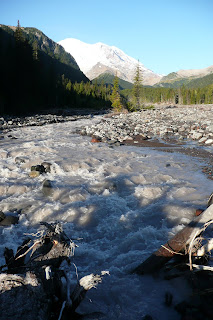

White River

We camp in a crowded but quiet place on the northeast slopes of "The Mountain." Thin, scraggly pine trees are full of Steller's Jays, the West's black-headed answer to Blue Jays, and a bold flock of scavenging Grey Jays. We fall asleep to the rushing of the White River, a small stream whose opaque, grey waters must fill its broad, rocky bed with whitewater in the springtime. Several groups of climbers pass our site, ice axes, crampons, and helmets strapped onto heavy-looking packs, heading cheerfully toward the mountain and quietly back from it. In the morning, we hike around Sunrise, where Rainier gifts us with a cloudless sky and overlooks of too much depth and breadth for our overworked cameras to capture. If I were superstitious, I might have imagined that I was making a pilgrimage to Rainier as the patron-spirit of the place that I hope to call home.


Chinook Pass

Burroughs Mountain overlook


September 12: Port Orchard, WA


After 4,353.05 miles and nearly a month of travel, the brave little Acura rolls safe and sound into my sister’s apartment complex in Port Orchard, Washington. I smell pine and saltwater. The Olympic Mountains provide a jagged horizon in the northwest. Seattle is hidden behind the many peninsulas of Puget Sound. I'll travel there soon enough on the search for employment, but for today, we simply enjoy not driving.


Thanks to everyone for being so supportive of this crazy adventure and for providing me with housing, entertainment, and friendship along the way. We'll see what happens next.


Odometer

Friday, December 5, 2008

Thursday, August 7, 2008

Book Report:
A Walk Across America,
Peter Jenkins

 
Peter Jenkins has reaffirmed his place as my almost-hero with his book A Walk Across America (1979).

It is quite obviously his first literary effort. The reader has to wade through gratuitous exclamation points and corny, unnecessary dialogue. His metaphors are either trite and empty or over-elaborate and clunky, rarely adding to the meaning or mood of his descriptions. He uses a new adjective before his dog’s name every time the dog is mentioned: “brave Cooper,” “powerful Cooper,” “playful Coops.” I wondered whether Jenkins had been studying Beowulf and its poetic epithets. The book reads like an unabridged adolescent’s diary.

If you manage to ignore the style, though, the underlying story is redeemingly amazing. Jenkins had just graduated from a small college in Upstate New York and was recovering from a dizzying marriage and divorce. He felt like he needed to go somewhere and considered traveling abroad because, along with the rest of his generation, he saw too many faults in America. A wise, old friend suggested that he see for himself whether America was worthless or worthwhile, and Jenkins decided to do just that. He would walk across the country with his dog, getting to know its people and places for himself, before passing final judgment.

This book follows him from Alfred, NY to New Orleans. (A sequel takes him the rest of the way west.) At first, he simply enjoys the act of walking through the peaceful autumn countryside. He becomes comfortable sleeping amidst the Halloween-sounds of the nighttime woods and builds the stamina to walk 20 to 30 miles per day. Once snow begins to fall, Cooper’s puppyish enthusiasm with jumping through snow banks energizes them both. He spends a few days on the Appalachian Trail but turns off when he remembers that his goal is to understand local people.

When he runs out of money, Jenkins stops in friendly towns to find work. He lives with a black family in their trailer in the Appalachian foothills. He spends a few weeks in an old-fashioned Southern plantation and on a commune. He wins the trust of a notoriously crotchety hermit, surprising nearby villagers, who placed bets on whether Jenkins would return alive. He shakes hands with Governor George Wallace. He ends up in a seminary in New Orleans to write a memoir for National Geographic. He is honest about his stereotypes of people and places, cultivated in a buffered, Eastern upper-crust suburbia, but he is willing to march through his phobic preconceptions and discover what life is really like at a Christian revival and on an Appalachian farm. Again and again, he is surprised by the friendliness and generosity of the people.

Jenkins’ epic story wraps itself up as nicely and magically as a fairy tale. By the time he reaches Louisiana, he has found not only faith in America but also a career as a writer, religion, and a fiancĂ©. He has lived through a tornado, drunken brawls, small-town suspicion, a deadly strain of influenza in a backwoods cave, and even the death of his beloved dog. Having read his 2001 Looking for Alaska, I am reassured that both this second marriage and his writing career flourish (and that he learns to conserve exclamation points and euthanize strained metaphors). The moral of the story: if you trust your instincts and trust other people, the rest of life will fall into place.

How perfect: the hero journeys away from home into the unknown wild-lands in order to have many adventures and find his place in life. Joseph Campbell would be proud.

That’s the kind of heroic challenge I’d sign up for. Even though I’ve fallen in love with Ithaca--wacky, liberal, smug Ithaca--I feel like I’m waiting for something. Maybe that’s a consequence of perennial unemployment, or maybe I’m getting anxious after living in one place for so long. I spend my days fencing, hiking, biking, journaling, and daydreaming. I have no epic project to work on, no heroic goal to aim for. Earning a degree would fit into that category. For some people, performing on Broadway or competing in the Olympics also fits. Maybe raising children does, too. I’m ready--desperate--for something to dedicate myself to, even something as senseless as walking across a continent.

Any suggestions?

Wednesday, August 6, 2008

Logbook Wisdom

 
Leave a blank book in the middle of the woods for a year, and what happens? It becomes a Rorschach test for hikers, except the hikers leave the inkblots. The books are part community message board, part graffiti canvas, part group diary, and part rainy day diversion. Most entries record little more than names, dates, and destinations, with occasional musings on the beauty of the surroundings, but here are a few other uses that hikers thought up:

  • Thank-you card: “Dear lean-to adopters and trail maintenance crews...”
  • Autograph collection: What would your trail name be? I followed the exploits of the likes of the Rondackers and Bachelor Bob. A string of letters and numbers followed some names: NTP 2004, LT 99, AT, GA-->ME 06-07. This code is the hikers’ version of adding Ph.D. or F.R.S. to their names, like medals of honor, or brief resumes of the trails they’ve walked. Bachelor Bob followed his name with alphabet soup, which lent weight to his frustrated criticisms of signage and trail maintenance issues. Since I was walking in his footsteps for a few days, I could only commiserate in my own entries.
  • Travel guide: Most NTP hikers walk northward, so the rare southbound hiker reaps a harvest of cautions and recommendations about the trail ahead.
  • Opinion forum: Hot topics include the necessity of fire bans and the tension between historical preservation, public accessibility, and the wilderness aesthetic. Also popular are impassioned essays against the inevitable lean-to litter.
  • Breadcrumbs: A rescue party can play connect-the-dots until they find where a missing person’s entries leave off.
  • Directory: Entries noted the best firewood-gathering grounds and the most productive fishing spots.
  • Confessional: A gay couple confessed to accidentally “showing off” while skinny dipping to a Boy Scout Troop. Unsurprisingly, such incidents happen on an apparently regular basis.
  • Religious testament: Spiritual moments strike people often in the wilderness, but I was confused by the praises to God’s aesthetic sense at Duck Hole, a reservoir.
  • Sketchbook: A few disturbingly practiced adolescent drawings wait patiently among entries, hoping to shock unsuspecting browsers. Elsewhere, innocent illustrations retell hikers’ adventures in graphic-novel style.
  • Backwoods girl talk: “When Aunt Flo comes calling a few days early, sphagnum moss offers a comfy and absorbent solution.”
  • Weather monitoring station: Dripping wet hikers need somewhere to vent their weather-related frustrations.
  • Wilderness survival guide: “Remember the computer game Oregon Trail: meager rations and a grueling pace means everyone dies!


Tuesday, August 5, 2008

The Pantry According to Rachel

To be recited prior to the ceremony of the Ingestion of the Animal Crackers.

1 Praise Thee, O Circus Animal Crackers!

2 Never before this Day have You been so anticipated through such Tribulations and through so many mud Puddles.

3 For you are the perfect Union of refined Sugars, enriched bleached Flour, red Dye #2, partially hydrogenated palm kernel, soybean, cottonseed, and/or canola Oil, and traces of Peanuts.

4 No multitudes of pestilential Blackflies nor host of bloodthirsty Mosquitoes can dissuade me from partaking of Your pink and white Frosting.

5 Your cookie Center imparts Strength unto weary Muscles, and your multicolored Sprinkles bring joy to heavy Hearts.

6 This Day the very Weather turned against me, but through this Flood, You have remained at my Back (specifically, in the confines of my Pack).

7 May you be forevermore my Source of Sustenance in the Wilderness!


Food Poetry

 
Oatmeal, oatmeal, perfect food,
Breakfast, cookies, lifts my mood.
Gorp, granola, raw or stewed,
Fills me up with fortitude!
 

Sing Along

To the tune of the Scout camp "Swimming Hole" song,
composed during a rather wet day over a mountain pass.


Hiking, hiking, on the mountaintop,
Wet's the day, but stay and play
In the muddy glop!
Uphill, downhill, tramping 'til you drop,
Don't you say this mountain day
Should never, ever stop!
 

Sunday, August 3, 2008

Musings from Blackfly Season


  • When I squish blackflies on my face, is their cause of death blunt trauma or drowning in saltwater?
  • How many calories are in a blackfly? There’s not much meat on one, but think of them like grains of sand on a beach. With as many as I caught in my tent each night, I could have had a hearty meal. They already flavored my oatmeal and pasta. I’m surprised I didn’t choke by breathing them in.
  • Do blackfly guts count as hair-care products? After a few days, I had more of that on my scalp than shampoo.
  • If humans are 80% water, how much water is in a blackfly? It sounded like it was raining when I sat in my tent, but it was the ticking of many dozen blackflies throwing themselves against the tent wall. I put on my raincoat to go outside, with the hood up and the sleeves cinched tight around my wrists. I used my scarf more for insect protection than for its intended purpose.
  • Do insects make inter-species alliances? I could usually escape blackflies by jumping into a river. At the Cedar River Flow near Wakely Dam, however, I was nibbled above by flies and below by fish. That was not fair.

Blackflies Versus Customers

I quit my retail job to go hiking in the thick of blackfly season. This is why.

Why Blackflies are Preferable to Customers

  • The police don't have to get involved when you squish the life out of a blackfly.
  • Customers are there all year round.
  • Blackflies are supposed to have the IQ of an insect.
  • They both carry diseases, but the bite of a customer is more painful.
  • I've never had a blackfly become belligerent when it sees through my attempts to fake a full working knowledge of hedge trimmers.
  • Blackflies don't care whether the surrounding plants are perennials or annuals.
  • In polite conversation, it is acceptable to refer to blackflies as part of the local wildlife.
  • Blackflies prefer to stay downwind.
  • There's a spray for blackflies.

Saturday, July 12, 2008

How to Avoid Adirondack Bears


Post Title
   Adirondacks   


And this is where the post will set up camp.